
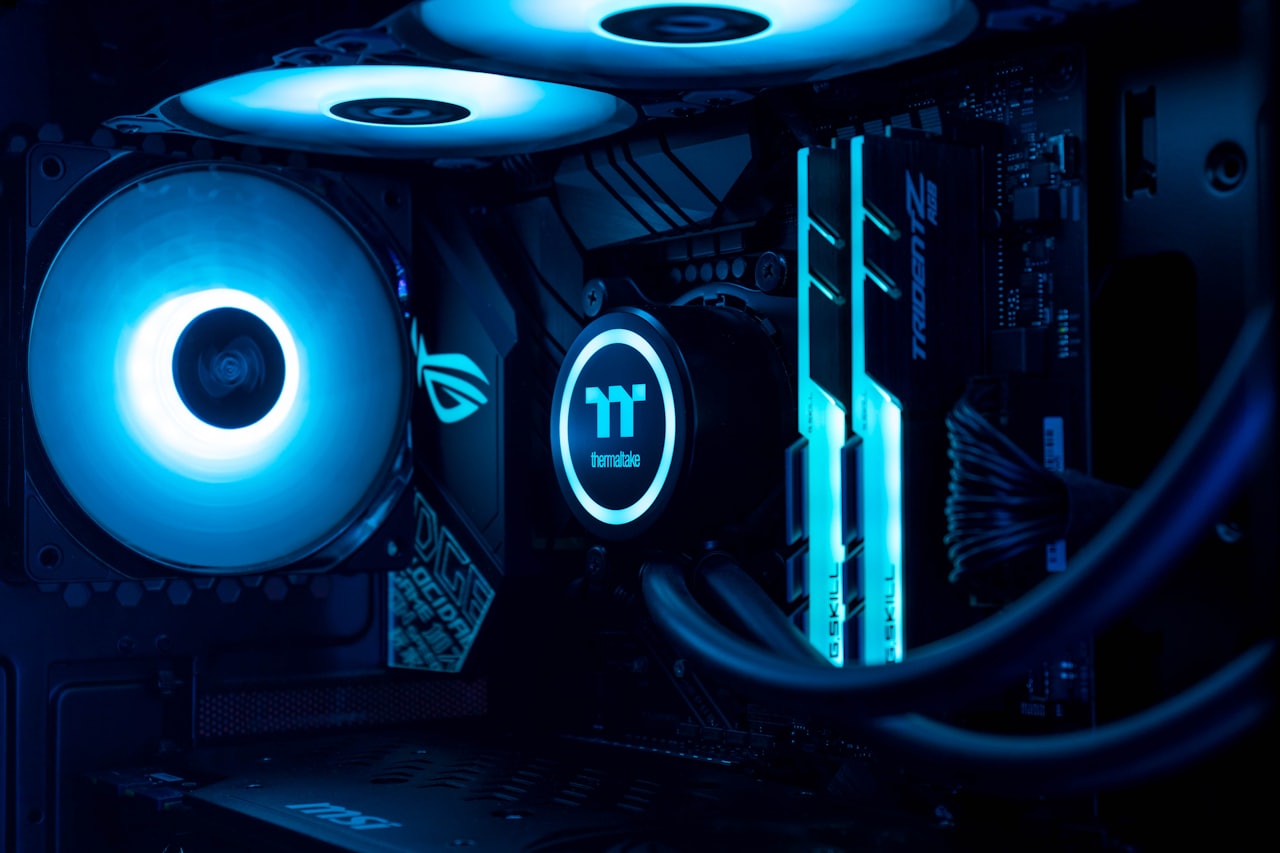

Direct Liquid Cooling (DLC) is what makes 50–130 kW AI racks possible. But a reliable system is far more than “water to the chip” — it is a precisely engineered loop where component selection, water cleanliness, and metallurgy determine whether it runs for years or fails in months.
The core components
Cold plates
Micro-channel plates mounted directly on GPUs and CPUs, capturing heat at its source.In-rack manifolds
Vertical supply/return distribution with dripless quick-disconnects for safely hot-swapping servers.CDU — Coolant Distribution Unit
The heart of the system: a liquid-to-liquid heat exchanger that isolates the clean secondary loop from facility water, redundant (N+1) variable-speed pumps, an expansion reservoir, filtration, and a PLC controller that holds supply temperature above dew point to prevent condensation.Two separate loops
The Facility Water System (FWS / primary) to chillers or dry coolers, and the closed, clean Technology Cooling System (TCS / secondary) that touches the IT.Instrumentation
Flow, differential-pressure, temperature and conductivity sensors, plus leak-detection cabling beneath the racks.Why water-inlet cleanliness is critical
Cold-plate micro-channels are only fractions of a millimeter wide. Any particulate in the loop causes clogging, hot spots, thermal throttling — and ultimately hardware damage. A properly engineered system therefore requires:
- Fine side-stream filtration (typically 50 µm or finer) on the secondary loop.
- Treated or deionized fill water — never raw tap water.
- Controlled chemistry — biocides to stop biofilm growth, inhibitors against scaling, and pH control.
- Pre-commissioning flush and clean of every loop before servers are connected.
Material and metallurgy compatibility
Mixing dissimilar metals in one wetted loop — for example copper cold plates with aluminum components — creates a galvanic couple that drives corrosion, blockages, and leaks. A robust design demands:
- Compatible wetted materials (copper, 316 stainless steel, brass), avoiding bare aluminum unless fully inhibited.
- Corrosion-inhibitor coolant packages matched to the exact metals in the loop.
- Flow velocities controlled to prevent erosion-corrosion.
- Compliance with manufacturer (e.g., NVIDIA), ASHRAE and OCP coolant specifications.
Get the loop chemistry and metallurgy right, and DLC delivers years of dense, efficient, reliable AI compute. Get it wrong, and the failures are expensive — and entirely avoidable.
B.A.T (Business Advanced Technology) engineers liquid-cooling-ready data centers end to end — thermal design, CDU and loop integration, water treatment, material selection, and commissioning.